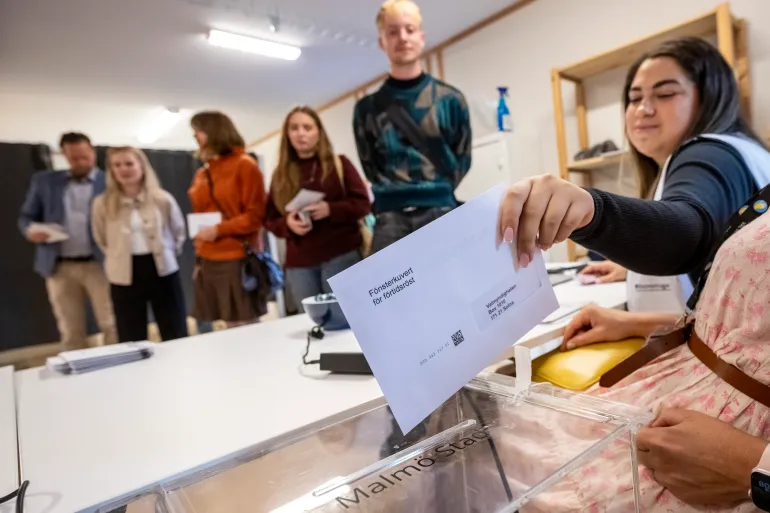
Sweden’s government is offering eligible migrants up to 350,000 kronor to voluntarily leave the country. As voters head to the polls, the program has become a symbol of a much larger transformation in Swedish immigration politics — even as questions remain about how many people it is actually causing to leave.
In Sweden, a government program once obscure enough to attract little public attention has become one of the clearest symbols of the country’s changing approach to immigration.
Since January, certain migrants living legally in Sweden have been eligible to receive as much as 350,000 Swedish kronor — roughly $37,000 — if they voluntarily leave the country and settle elsewhere permanently.
For a married or cohabiting couple, the maximum is 500,000 kronor. A household can receive as much as 600,000 kronor.
The numbers are large enough to generate an easy international headline: Sweden is paying immigrants to leave.
The reality is considerably more complicated.
The program applies only to specific categories of noncitizens with qualifying residence permits. Swedish citizens are not eligible. Neither are Ukrainians living in Sweden under the European Union’s Temporary Protection Directive, nor people intending to relocate elsewhere within the European Economic Area or Switzerland.
And despite the size of the payment, there has been no mass rush for the exit.
Sweden’s Migration Agency, Migrationsverket, recorded 725 applications through the end of July, while Reuters reported on September 8 that 171 people had taken up the government’s offer.
Exactly how that latter figure translates into completed departures is less clear. Sweden’s publicly available statistics track applications and case decisions but do not currently provide a continuously updated number showing how many recipients have physically left Sweden, received each stage of the payment and remained abroad.
That distinction lies at the heart of the debate now surrounding the program.
The government describes voluntary repatriation as an option for people who have struggled to establish themselves in Swedish society and may have better prospects beginning again somewhere else.
Critics see something more symbolic: a policy whose political message may be reaching far more people than the relatively small number who have applied to use it.
A Dramatic Increase
Sweden did not invent voluntary repatriation in 2026.
The country has offered some form of financial assistance for immigrants who voluntarily leave since 1984.
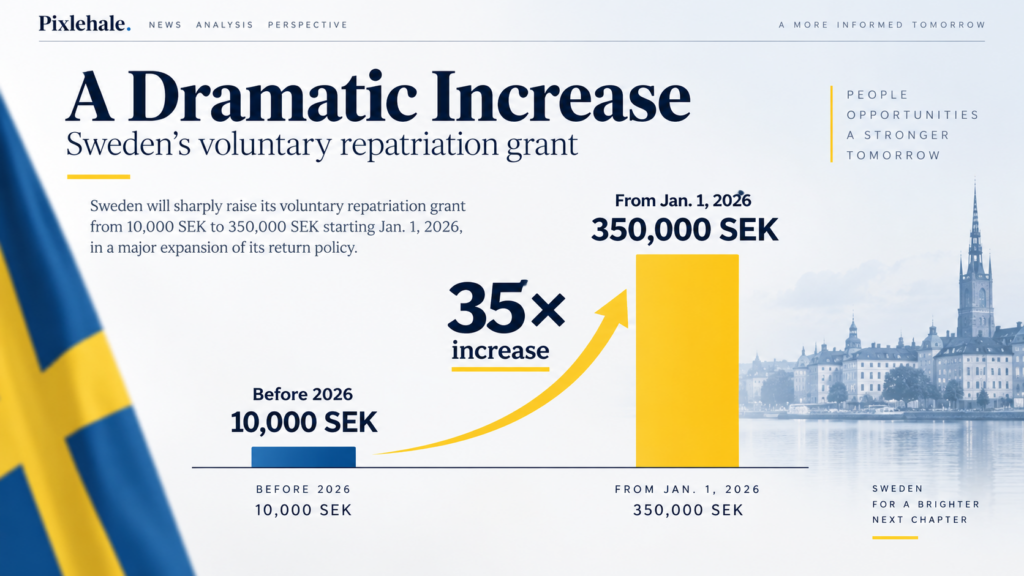
What changed was the amount.
The previous system offered an adult a maximum cash benefit of approximately 10,000 kronor. Beginning January 1, 2026, that maximum increased to 350,000.
The government has said the larger payment can provide a genuine opportunity for people who have experienced long-term unemployment, isolation or difficulty integrating into Swedish society to establish a new life elsewhere.
Migration Minister Johan Forssell has defended voluntary repatriation as one piece of a broader immigration and integration strategy.
But receiving the money is more complicated than accepting a check and boarding an airplane.
Payments are made in stages. An approved applicant initially receives only part of the grant. Additional portions become available after arriving in the destination country, while the final payment generally requires the recipient’s Swedish residence permit to have expired or been revoked.
Recipients may also be required to repay the grant if they fail to leave, later resettle in Sweden or obtained the money using incorrect information.
This makes the program less like a plane ticket home and more like a state-financed agreement to permanently relocate.
Sweden Studied the Idea Before Expanding It
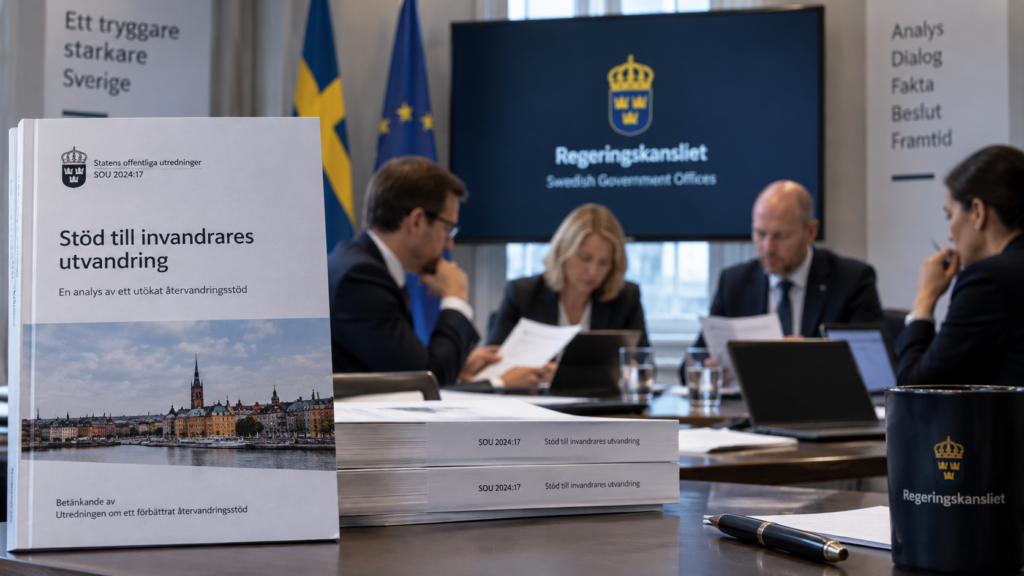
One of the most striking elements of Sweden’s policy is that the government commissioned an investigation into voluntary repatriation before dramatically increasing the payment.
The resulting 2024 government inquiry, Stöd till invandrares utvandring, examined whether financial incentives could significantly increase the number of immigrants voluntarily leaving Sweden.
Its findings were hardly definitive.
The inquiry looked particularly closely at Denmark, which has operated a more extensive repatriation system for years.
Using the Danish experience as a model, investigators estimated that a Swedish grant of roughly 350,000 kronor might eventually be associated with around 1,300 subsidized departures annually.
But the same analysis estimated that approximately 600 of those people might have left Sweden even without receiving the grant.
That distinction is crucial.
If someone was already planning to leave Sweden, paying that person 350,000 kronor does not necessarily mean the payment caused the departure.
The inquiry ultimately reported that it had not found an example of a policy capable of producing the kind of dramatic increase in voluntary emigration it had been asked to identify.
That did not stop the government from moving forward.
It means Sweden is now conducting something close to a real-world experiment: whether a much larger financial incentive can change behavior where previous programs produced limited results.
The Politics Became Impossible to Separate From the Policy
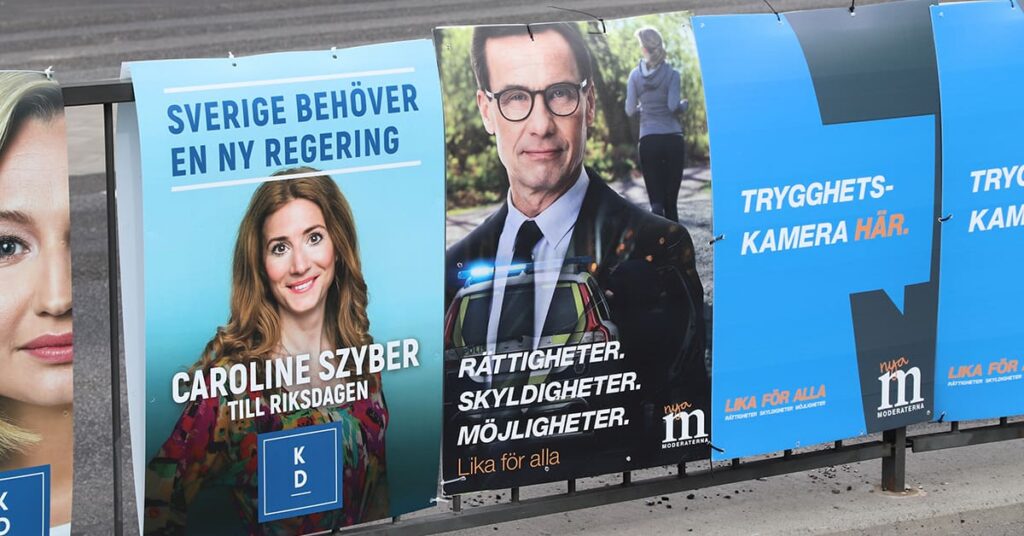
The enhanced grant was announced in October 2025 and took effect months before Sweden’s September 13 election.
But as the campaign intensified, the program became something larger than an administrative policy.
The Sweden Democrats, the nationalist party that has exerted substantial influence over the center-right government’s immigration agenda, made repatriation part of its political messaging.
One advertisement placed on public transportation reportedly asked:
“Do you miss Mogadishu?”
It then promoted the repatriation grant.
According to Sveriges Radio, around 20 bus drivers of Somali origin in Skaraborg stayed home in protest after the advertisements appeared. The regional transport company Västtrafik later removed the campaign material.
The incident illustrated a central tension surrounding the program.
There are effectively two audiences.
One is the immigrant who might genuinely consider leaving Sweden.
The other is the Swedish voter who will never apply for the program but sees its existence as evidence of a fundamental change in the country’s immigration policy.
A policy can serve both purposes simultaneously.
The government can genuinely believe voluntary repatriation offers some migrants a better option while the same program functions politically as a signal that the Swedish state is prepared to encourage departure rather than focusing exclusively on integration.
The People Behind the Numbers

For some recipients, the program offers exactly what its supporters promise: a chance to begin again.
Swedish broadcaster SVT reported this summer on Golahmad Jamili, a 67-year-old man living in Höör who had been approved for 350,000 kronor to return to Afghanistan.
Jamili had come to Sweden after two of his sons were killed in Afghanistan. After seven years in Sweden, he described struggling with language barriers and isolation.
The grant presented an opportunity to purchase a small home and rebuild his life elsewhere.
Then the practical problems began.
Afghanistan’s place within the international financial system made transferring large sums of money extraordinarily difficult. According to SVT, Jamili discovered that he could not simply transfer the money to Afghanistan, while his Swedish bank would not allow him to withdraw the entire amount in cash.
He had already given up his Swedish apartment.
The case exposed a weakness that cannot be captured by an application statistic: paying someone to return and successfully resettling that person are not the same thing.
People returning after years abroad may encounter problems involving housing, banking, employment, documentation, security and family relationships.
Money can address some of those problems.
It cannot necessarily solve all of them.
At the opposite end are immigrants who know about the program and simply do not want it.
Reuters spoke with immigrants at a community center in Sätra, a working-class Stockholm suburb, and reported that those interviewed were aware of the grant but had no interest in accepting it.
For people who associate Sweden with personal security, employment, family or a future they have spent years building, even 350,000 kronor may not fundamentally change the calculation.
Sweden’s Municipalities Push Back
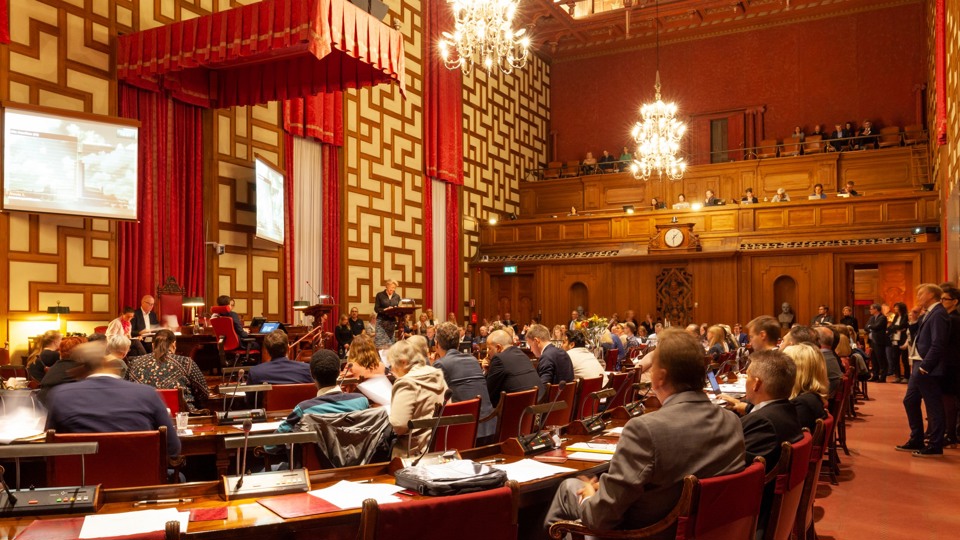
Resistance has also come from an unexpected direction: local government.
More than 130 of Sweden’s 290 municipalities reportedly declined invitations to participate in discussions with the national government’s coordinator for voluntary repatriation last year.
The opposition included major cities such as Stockholm, Gothenburg and Malmö, but it was not limited exclusively to municipalities governed by Sweden’s political left.
Some local officials objected to the program philosophically.
Others raised a more practical concern.
They need workers.
Sweden, like much of Europe, faces an aging population and growing demand for workers in healthcare, elder care and other public services.
Foreign-born workers already make up an important part of that labor force.
That creates an unusual policy contradiction.
From the national government’s perspective, encouraging a person who is chronically unemployed or socially marginalized to leave may reduce future public spending.
From a municipality’s perspective, immigrants can also represent part of the solution to severe workforce shortages.
Both can be true.
And that makes the economics of repatriation considerably more complicated than simply subtracting a welfare payment from the national budget.
Is the Program Working?
That may be the simplest question surrounding Sweden’s experiment — and currently the hardest to answer.
A raw number of applicants does not measure effectiveness.
Neither does the number of people receiving approval.
To understand whether the program works, Sweden ultimately needs to answer several different questions.
How many recipients actually leave?
How many remain abroad?
How many would have emigrated anyway?
How much money is ultimately distributed?
How much does Sweden save in reduced government expenditures?
What happens to recipients after they resettle?
And what effect does the policy have on immigrant communities that remain in Sweden?
The government’s own earlier investigation warned that even relatively small negative effects on integration or social trust could offset some of the program’s projected financial benefits.
That warning has become particularly relevant as voluntary repatriation moves from government paperwork into election advertising and national political identity.
A Different Sweden
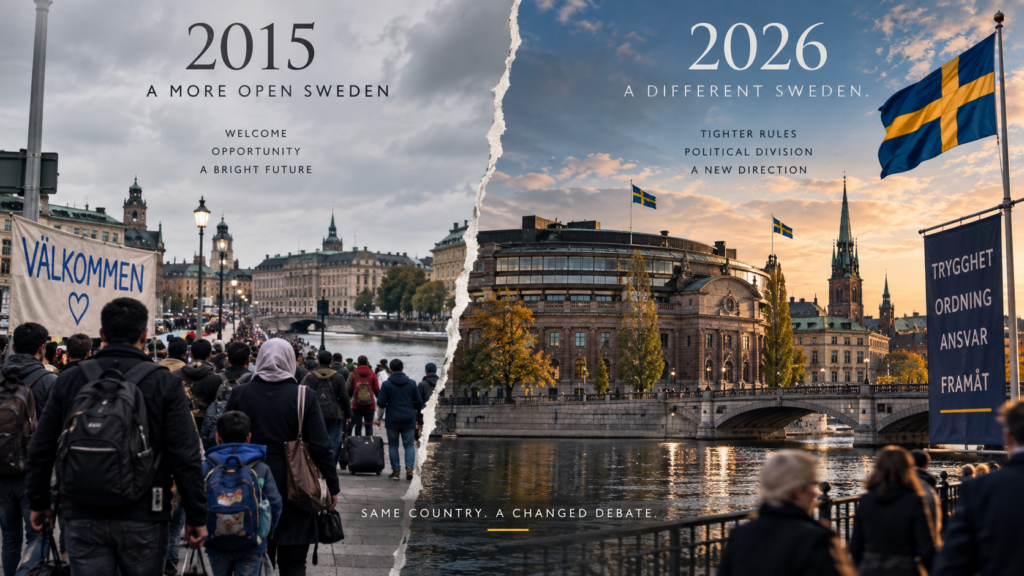
This debate is ultimately about something larger than 350,000 kronor.
Sweden admitted approximately 163,000 asylum seekers during the migration crisis of 2015.
A decade later, the political climate surrounding immigration bears little resemblance to that period.
The center-right government has significantly tightened immigration policy. The Sweden Democrats have moved from political outsiders to a force capable of shaping national policy, and Prime Minister Ulf Kristersson has opened the possibility of the party entering government if the right retains power.
Even the opposition Social Democrats now support a significantly more restrictive immigration policy than Sweden maintained during much of the previous decade.
The argument in Swedish politics is therefore no longer simply about whether immigration should be reduced.
That shift has largely already happened.
The emerging argument is about what governments should do with people who have already arrived.
Should policy focus on integrating them?
Should financially struggling residents be offered another route?
Should governments actively encourage some legal residents to leave?
And at what point does offering an option become sending a message about belonging?
Sweden’s repatriation grant cannot answer those questions by itself.
But it may reveal where European immigration politics is heading next.
For years, the central political debate across Europe concerned who should be allowed to enter.
Sweden is now testing a different proposition:
Whether governments should actively incentivize some of the people already living there to leave.
The program may eventually produce thousands of voluntary departures.
It may remain relatively small.
Either outcome matters.
Because nine months after Sweden dramatically increased the price of voluntary return, the political influence of the policy is already far larger than the number of people documented as using it.
And that may ultimately be the most important number of all.
Sources: Key data, policy details, and statements in this article are drawn from the Swedish Migration Agency (Migrationsverket), Swedish government and parliamentary documents, the 2024 government inquiry on voluntary repatriation, Reuters, SVT, Sveriges Radio, and other Swedish public reporting. Additional context was drawn from official statistics, municipal responses, and coverage of Sweden’s 2026 election and broader immigration debate. Reporting and analysis by Pixlehale staff. Additional source review from Swedish government records and local media coverage. All figures and claims were cross-checked against available primary and reputable secondary sources to provide a factual, balanced account of the policy and its political impact.