
Prefer to listen instead?
Nathan Fielder and Lance Oppenheim spent three years filming Elizabeth Holmes’s life after Theranos — and the closer the cameras got, the slipperier the truth became. Hear our full review of You Can See Everything, brought to you by Pixlehale.
Full disclosure, in the spirit of the film: I fell asleep the first time.
Not because the movie was boring — it is very possibly the best film I have seen in years — but because life intervened. I caught You Can See Everything at the Paragon Theaters in Falls Church, Virginia, days after coming home from Montreal, running on travel fumes. Somewhere in the second half, exhaustion won. I woke up knowing two things: I had missed crucial pieces of the strangest documentary in recent memory, and I had to go back.
So on Tuesday, October 27, I sat down at the Regal Ballston Quarter in Arlington and watched all 174 minutes again, wide awake.
Here is the thing nobody warned me about: seeing more of it did not settle anything. It did the opposite. The second viewing made Elizabeth Holmes harder to read, made her partner Billy Evans more unsettling, made the filmmakers’ choices more impressive — and left me with a conclusion I can’t shake, which happens to be the film’s own thesis. You can see everything, and still not know what you’re looking at.
The setup: 34 days, one beach house, three years
The premise sounds like a stunt, which is Nathan Fielder’s natural habitat. In April 2023, 34 days before Elizabeth Holmes was due to report to federal prison, she and Billy Evans invited Fielder and co-director Lance Oppenheim (Ren Faire, Primetime) to move a small crew into their rented beach house in Del Mar, California, and document — per A24’s synopsis — her every move. A24, remarkably, imposed no deadline and no obligation to deliver a finished film. Fielder has said the crew knew they had something when the crew members themselves began disagreeing about what was happening inside that house.
For anyone who needs the refresher: Holmes founded Theranos in 2003 on the promise of running hundreds of diagnostic tests from a drop of blood. The technology never did what the company claimed. In January 2022, a federal jury convicted her on four counts tied to defrauding investors — one conspiracy count and three wire fraud counts. She was acquitted on the patient-related counts, a distinction that matters and that this article will keep making. In November 2022 she was sentenced to 135 months — eleven years and three months — plus $452 million in restitution, owed jointly with her former partner Sunny Balwani, who was convicted on all twelve of his counts, including fraud against patients. She reported to the minimum-security Federal Prison Camp in Bryan, Texas, on May 30, 2023. Her sentence was reduced to ten years and three months in March 2026 under a retroactive change to federal sentencing guidelines. That is the legal record. Everything in the film happens in its shadow.
The film premiered as a secret screening at Telluride on September 6, 2026 — attendees surrendered their phones without knowing what they were about to see — and opened in U.S. theaters on October 16. Audiences have treated it like an event: a $15.6 million opening weekend, the second-biggest ever for a non-musical documentary, on its way to $65 million worldwide against a $7 million budget, with a 96% Rotten Tomatoes score and a 97 on Metacritic. New York Times critic Manohla Dargis praised a film that speaks “uncannily to the pathos and destabilizing confusions of the present.” For a three-hour documentary about a convicted fraudster, her partner, and the limits of knowing anyone — that is not a niche result. That is a phenomenon.
The paradox at the center
Most documentaries about Elizabeth Holmes ask whether she lied. Fielder and Oppenheim ask a colder question: what would it even look like to know?
The camera gets everything. Domestic tenderness with her two children. Earnest defenses of Theranos — in the film, pressed on how she promoted a device that didn’t work, Holmes denies intentionally misleading anyone and argues her words were semantically misinterpreted, a distinction she appears to genuinely inhabit. Long, strange silences. At one point Fielder screens the Abbott and Costello routine “Who’s on First?” for the couple to dramatize his own frustration at conversations that never land; Holmes says she finds it funny, then, pressed, says she doesn’t understand the joke. Evans offers that this is simply how she “thinks differently.”
Visibility, the film keeps demonstrating, is not the same as access. A camera can record a face. It cannot record an intention. The more footage accumulates, the clearer it becomes that everyone in the house — Holmes, Evans, and eventually the filmmakers — is performing for someone, and the performances may not even be dishonest. They may simply be what people do when the stakes are their freedom, their family, and their name.
That is why the film needs 174 minutes, why it needs reenactments, and why it needed, for me, a second viewing. It is not withholding its answers. It is arguing, patiently, that the answers were never in the footage to begin with.
Sympathy is not the same as a verdict
The film’s most uncomfortable achievement is how human it makes Holmes seem — a mother facing separation from her small children, isolated, dependent on Evans for contact with the outside world. It would be a lie to say that doesn’t land. It landed on me.
But a documentary’s emotional center is a choice, and here’s where my second viewing turned critical. Across nearly three hours, I cannot recall Holmes offering a substantial reckoning with the people on the other end of Theranos’s claims: the patients who received results from technology that didn’t work, whose medical decisions hung on numbers nobody should have trusted. Her regrets, as presented, orbit the company’s failure, her reputation, and her own consequences. The distinction is subtle and it is everything: believing passionately in a breakthrough is not the same act as claiming the breakthrough has already happened. Theranos was prosecuted for the second claim dressed up as the first, and on screen, Holmes still seems unable — or unwilling — to hold those two ideas apart.
None of this requires deciding whether her vulnerability is real. It may be. Personal vulnerability does not erase criminal responsibility; criminal responsibility does not make a person immune to manipulation. Both propositions can be true at once, and any honest reading of this film has to hold them simultaneously — which is more than the film’s subject sometimes seems able to do for herself.
Billy Evans, and the gravity well
If Holmes is the film’s enigma, Evans is its engine. Two years after Holmes reports to prison, the production resumes around him — and around Haemanthus, the blood-testing startup he founded in 2024, built on Raman spectroscopy: lasers reading the molecular signature of blood, saliva and urine, with artificial intelligence in the loop, pets first, humans later. The company has raised millions, holds a patent, and insists, in its own words, “This is not Theranos 2.0.”
On camera, though, Evans tells a different story with his own mouth. In the film he describes the venture in terms of getting the old team back together — Fortune’s reporting on the documentary quotes him calling the idea “put the band back together and do it all again” — and multiple accounts of the film have him using the phrase “Theranos 2.0” himself. His former CTO has resigned. Fortune found no independently validated results. None of that is proof of wrongdoing — a distinction worth keeping, because starting a diagnostics company is not a crime. But it is proof of something else: an appetite for the comparison that no amount of corporate denial can fully walk back.
What the film documents around Evans is a pattern of control over access and image, and the filmmakers show their work rather than asking you to trust their narration. As depicted in the film: Evans ends an interview with a Haemanthus engineer who suggests Holmes lied about Theranos’s technology. He refuses to help Fielder reach Holmes in prison. He licenses Holmes’s image for billboards and for a deepfaked AI model of her. He posts on her X account in a voice Fielder and Amanda Seyfried conclude she would never use — Evans, confronted, says the posts draw from emails she sends him from prison. And in the film’s most quietly staggering sequence, actor Christopher Abbott plays Evans in a reenactment of an early meeting — one Holmes wasn’t in the room for — in which Evans asked for a cut of the documentary’s profits. The filmmakers reluctantly negotiated. Later, Holmes tells Fielder she is receiving no money from the film. On-screen text at the end confirms Evans relinquished the profit share before release. What it cannot confirm is whether she knew.
Evans, confronted on camera, states that he holds power of attorney over Holmes and that she knows “some” of the details. The exact scope of a power of attorney lives in the document, not in a documentary — the film can’t show it to us, and we shouldn’t pretend otherwise. But step back and the shape is hard to unsee: a woman in a federal prison camp, owing hundreds of millions in restitution (Holmes herself, in the film’s prison-visit reenactment, says she prefers to leave financial decisions to Evans for exactly that reason), whose public voice, public image, synthetic likeness, and documentary access all route through one man — who, late in the film, also mentions that he always carries a gun, and briefly threatens to ruin the lives of people he believes have wronged her before retracting it.
Is he manipulating her? Is she directing him? Are they running a shared strategy to rehabilitate her name — or is this simply what loyalty looks like from inside a catastrophe? I went in leaning toward the first answer. I came out of the second screening unable to certify any of them, and suspicious of anyone who claims they can.
Seyfried, the reenactments, and the filmmaker in the frame
The film’s boldest device arrives via Emma Stone, who introduced Fielder to Amanda Seyfried — television’s Elizabeth Holmes, Emmy-winning star of The Dropout. Seyfried watches the Del Mar footage, then steps back into the role: reenacting, opposite Abbott’s Evans, the private conversations the cameras never captured. Holmes herself can’t sit through The Dropout when Fielder screens it; in the prison-visit reenactment, she complains her fellow inmates treat the series as fact and mistreat her for it.
It sounds like a gimmick. It plays like an interrogation — of everyone. Seyfried becomes the audience’s proxy and the film’s internal critic, pressing the question the whole documentary is circling: has Fielder gotten too close? When she suggests he has lost objectivity through attachment to Holmes, the film doesn’t defend itself. It leaves the charge hanging, because the honest answer is that nobody can audit their own bias from inside it. Fielder’s transparency about that — including footage of his own uncertainty, set to Ari Balouzian’s score, which pointedly borrows from Bernard Herrmann’s Vertigo, Hitchcock’s opera about a man remaking a woman into an image — is not a confession of failure. It is the method. A filmmaker who shows you the seams is not asking for your trust. He is asking for your vigilance.
Can a reenactment tell the truth? The film’s answer is that a labeled reconstruction, openly sourced from one party’s memory, can be more honest than unlabeled certainty — and that “the camera was there” was never the guarantee we treated it as.

Who owns Elizabeth Holmes?
Buried in the film is the thread that may matter most in ten years. Before reporting to prison, Holmes has her body 3D-scanned, and — on camera — voices concern about her likeness being misused. Later, per the film, Evans licenses that image anyway: billboards, and an AI model of a woman who cannot walk into a room and object in person.
Pair that with a social account that announces, in its own description, that its posts are mostly her words “posted by others,” and the question stops being about one couple. Who controls a person’s identity when their face, voice and public statements can be administered by someone else — with legal paperwork, with their partial knowledge, from behind prison walls? Consent given once, under duress of circumstance, for a family archive is one thing. Consent stretched into a commercial likeness is another. The technology doesn’t care about the difference. The law is only beginning to. On this, Pixlehale’s position is simple: a person’s synthetic self should belong to the person — revocably, verifiably, and never by default to whoever holds the passwords.
The people outside the frame
Every documentary about a charismatic defendant runs the same risk: the frame fills with the defendant’s humanity until the harmed become a footnote. Holmes was acquitted of defrauding patients, and that acquittal is a fact, not a technicality. It is also a fact that Theranos’s tests were real products used by real people, that regulators found real failures, and that the company’s collapse left patients who had made real decisions on bad numbers. The jury’s verdict answers a legal question about specific counts. It does not retroactively make the technology accurate, and it does not discharge the moral accounting.
To its credit, the film seems to know this — which may be why it keeps returning to the gap between Holmes’s fluent self-defense and her silence on the receiving end of the harm. But knowing it and repairing it are different things. The patients are the missing center of You Can See Everything, and noticing their absence is, I think, part of watching it correctly.
The verdict
So: is it a masterpiece? After two viewings — one of them, I’ll admit, partially unconscious — I believe it is one of the best films of the year, and the rare documentary that changes the genre’s terms while you’re sitting in the theater. It demonstrates, with evidence rather than narration, how sympathy, access and apparent transparency can scramble an audience’s judgment without resolving a single factual question at the heart of a scandal. It refuses to call Holmes innocent or Evans a villain in terms it cannot prove, and in doing so becomes more damning and more compassionate than either verdict would be.
Its final suggestion is the one that has stayed with me for days: in a world where a public self can be engineered through selective access, a managed feed, a licensed likeness and an AI double, the boundary between authenticity and performance isn’t just hard to find. It may be the only story left. You can see everything. Understanding it is another matter — and that gap, Fielder and Oppenheim seem to say, is where all of us now live.
You Can See Everything is in theaters now, distributed by A24. Rated R, 174 minutes.
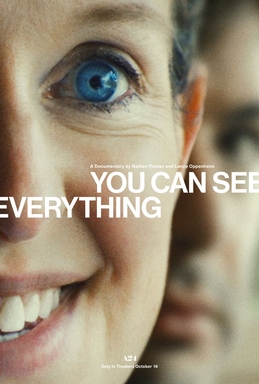
Sources: A24 (film synopsis and release information); Wikipedia, “You Can See Everything” (production, release and reception details, incl. Telluride premiere, box office and review aggregation figures, retrieved Nov. 2, 2026); People, “How to Watch the Elizabeth Holmes Documentary, ‘You Can See Everything’”; The A.V. Club, review of You Can See Everything; U.S. court reporting and the U.S. Department of Justice case record on United States v. Elizabeth Holmes (convictions, acquittals, sentence and restitution); Encyclopaedia Britannica, “Elizabeth Holmes” (sentence reduction, March 2026); Fortune, NPR and The Verge reporting on Haemanthus (funding, technology, company statements and the resignation of its CTO), retrieved Nov. 2, 2026. Theatrical poster: © A24, reproduced at low resolution to identify the film under review. Descriptions of scenes and statements attributed to the film reflect the documentary as released; character interpretations are the author’s, formed over two viewings (Paragon Theaters, Falls Church, VA; Regal Ballston Quarter, Arlington, VA, Oct. 27, 2026).
Read Next
What Does Haley Stevens Gain? The Endorsement That Only Helps Mike Rogers
Kendrick Lamar’s GNX: The Album That Reclaimed the West
The Evolution of Music in the Era of Streaming: What You Need to Know