
Tag: U.S. politics

  • From Cuts to Conflict: A Feature Draft on Executive Power in 2026

    Prefer to listen instead?

    From Washington to the world stage, Trump’s second phase is shifting the balance of power. Here’s what’s happening and why it matters. Powered by PixleHale.

    When the Trump administration returned to power, its opening strategy was clear: move fast, cut deep, and disrupt the federal system from within. Agencies were downsized, budgets were slashed, and an unconventional alignment with private-sector figures—most visibly Elon Musk—signaled a new governing philosophy. In the early months, it was framed as reform. One year later, it looks more like transformation: not only of government structure, but of power itself. 

    The argument, from the beginning, was that the federal state was bloated—too slow, too expensive, too insulated from performance and consequence. The remedy was managerial: reduce headcount, consolidate functions, automate where possible, and centralize “efficiency” inside a new apparatus intended to do what Congress and agencies, in this view, would not do for themselves. 

    But governing is never just management. It is also coercion, legitimacy, and the daily burden of proof: can the state still deliver what the public expects—safety, services, stability—after it has been deliberately thinned?

    A smaller workforce, a larger wager

    By the end of 2025, the scale of the reduction was no longer theoretical. Analyses of government data found a net decline on the order of hundreds of thousands of positions—an unusual contraction for a modern federal workforce whose obligations remain fixed by law and by crisis. 

    The numbers vary by measurement window and dataset, but the direction is consistent: separations soared while hiring dropped, and younger, newer employees were hit hardest—suggesting a system that shed not only “bureaucracy,” but the very pipeline that renews institutional memory. 

    The downstream effects have appeared unevenly—because government is uneven. Some offices, facing statutory deadlines or operational risk, rehired quickly. Others simply slowed. Service problems do not always arrive as a single collapse; they arrive as a widening queue: longer wait times, fewer inspectors, slower processing, more unanswered calls. 

    And the impact has not been contained to Washington. In the D.C. region alone, local economic reporting tied job losses and reduced pay to fiscal planning worries—less income-tax revenue, less consumer spending, and the quiet erosion of what had long been the city’s stabilizing economic sector. 

    The most consequential policy question is not whether government can be made smaller. It is whether, in practice, it can be made smaller without becoming brittle—unable to absorb shocks without improvisation, exceptions, or emergency workarounds that contradict the original logic of “efficiency.” 

    Enforcement comes home

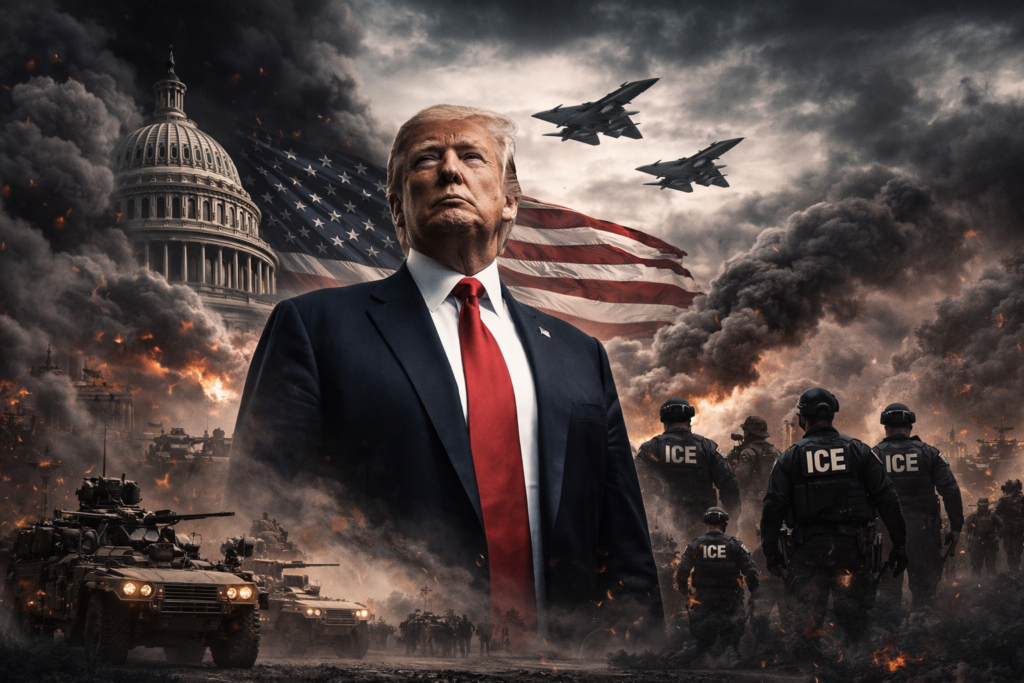
    While the government cut inward, it also expanded outward—most visibly through immigration enforcement. And on that front, the story has been less about spreadsheets than about streets: raids, protests, clashes over authority, and in several cases, deadly force. 

    Nowhere symbolized that collision more than Minneapolis. A large enforcement surge brought thousands of agents into the region and produced thousands of arrests, according to ICE. But it also produced a secondary economy of fear: families who stopped going to work, patients who missed medical appointments, students who disappeared from classrooms—spreading the consequences far beyond the individuals ICE was trying to identify and remove. 

    Members of U.S. Immigration and Customs Enforcement (ICE) detain an observer, who was later released, as part of U.S. President Donald’s Trump’s immigraton policy, in Minneapolis, Minnesota, U.S., January 6, 2026. REUTERS/Tim Evans

    The surge became nationally defining after two U.S. citizens were killed in shootings involving federal immigration agents. Federal and local accounts have repeatedly diverged, with local officials pointing to video evidence they say undermines federal claims of self-defense. 

    The pattern extended beyond Minnesota. In South Texas, the killing of U.S. citizen Ruben Ray Martinez in March 2025 drew little attention until records litigation and reporting revealed the federal role and raised questions about disclosure and narrative control. 

    Alongside shootings, deaths in custody became another pressure point. Reporting on individual cases—like the death of an Afghan immigrant shortly after intake—has been paired with broader allegations from lawmakers and advocates that rapid detention expansion is straining medical care and oversight, while DHS insists its screening and care processes remain adequate. 

    The deeper question, for the administration and for the country, is what this enforcement model produces when scaled: whether it can be aggressive without becoming indiscriminate, and whether the state can intensify coercion while also maintaining broad public legitimacy for how that coercion is used. 

    War abroad, consequences at home

    If domestic policy is now defined by contraction and enforcement, foreign policy has been defined by escalation.

    The U.S.-Israeli war with Iran—launched February 28 and described by U.S. Central Command as “Operation Epic Fury”—shifted the administration’s second year into a different register: major combat operations, contested maritime corridors, and a rapidly tightening link between military decisions and the price of daily life. 

    The administration has publicly described objectives in stark terms, while reporting captured frequent changes in messaging around end-state and timeline—an inconsistency that critics cite as evidence of poor planning and supporters frame as flexibility in war. 

    Operational metrics underscore intensity: by mid-March, U.S. Central Command reported 7,800+ targets struck and 120+ Iranian vessels damaged or destroyed, alongside thousands of combat flights. 

    And the war’s domestic impact is not abstract. Reuters/Ipsos polling reported that a majority of Americans say higher gasoline prices are already hitting household finances, and that the cost of living—long a central political vulnerability—has become even more exposed in wartime conditions. 

    Congress, meanwhile, has revived an old constitutional argument: who decides when “major combat operations” become war—and how long a president can sustain hostilities without explicit authorization. That debate has sharpened as lawmakers attempt, and fail, to constrain executive war powers through War Powers Resolution mechanisms. 

    Venezuela and Cuba: oil, leverage, and a hemispheric playbook

    The throughline between domestic enforcement and foreign escalation is not only ideology. It is also leverage.

    In Venezuela, the administration executed a high-profile capture operation against Nicolás Maduro and quickly pivoted toward managing oil supply in ways that appear calibrated to global energy pressures—authorizing certain transactions involving PDVSA while keeping payments and legal frameworks tied to U.S. oversight. 

    The diplomatic reset is visible: the U.S. flag has been raised again at the embassy in Caracas, seven years after its lowering—symbolic theater, but also a signal that the U.S. is building a new relationship with whoever holds power in Venezuela now. 

    Cuba has been treated differently: not as a partner to manage, but as a regime to squeeze. Reporting from Reuters and Time described an effective fuel blockade that has contributed to blackouts and humanitarian stress, while talks proceed under extraordinary pressure and Cuban officials reject U.S. demands that touch leadership succession. 

    The rhetoric has been blunt enough to become its own story. Trump has publicly described the possibility of “taking” Cuba, while U.S. officials emphasize “deals” and Cuban leaders frame the policy as an attempt to force surrender through economic suffocation. 

    The shape of the era

    Taken together, the past year suggests a presidency moving on two tracks at once: shrinking the administrative state while expanding the coercive state—more capacity to compel, less capacity to serve. That is a volatile combination, because legitimacy depends on both. 

    Supporters see coherence in the approach: a government that enforces borders, acts decisively abroad, and refuses to subsidize institutions it deems inefficient. Critics see overreach: executive power expanding faster than oversight, and a thin state that can still punish but struggles to deliver. Polling suggests the country remains polarized, with rising unease on cost-of-living pressures and limited public appetite for escalatory ground-war scenarios. 

    What happens next will not be decided by rhetoric alone. It will be decided by outcomes: whether services degrade, whether courts constrain, whether wars widen, whether markets punish, and whether communities accept the tradeoffs a sharper enforcement state requires. 

    Sources: Key insights and framing in this article are informed by reporting and analysis from major national and international outlets, including Pew Research Center, which provided context on public opinion trends and political polarization, as well as coverage from Reuters and Associated Press on federal policy developments, international conflicts, and economic signals tied to the administration’s actions. Additional analysis was drawn from PBS NewsHour and the Council on Foreign Relations, particularly regarding geopolitical dynamics involving Iran and Latin America, while reporting from The Guardian, Politico, and Semafor helped capture political reactions, legal developments, and evolving narratives across party lines. Additional context on immigration enforcement and federal restructuring was informed by publicly available reporting, official government statements, and releases from The White House and other federal records. This article was produced by PixleHale and its editorial contributors, with all interpretations based on a synthesis of these sources to provide a balanced and comprehensive perspective.
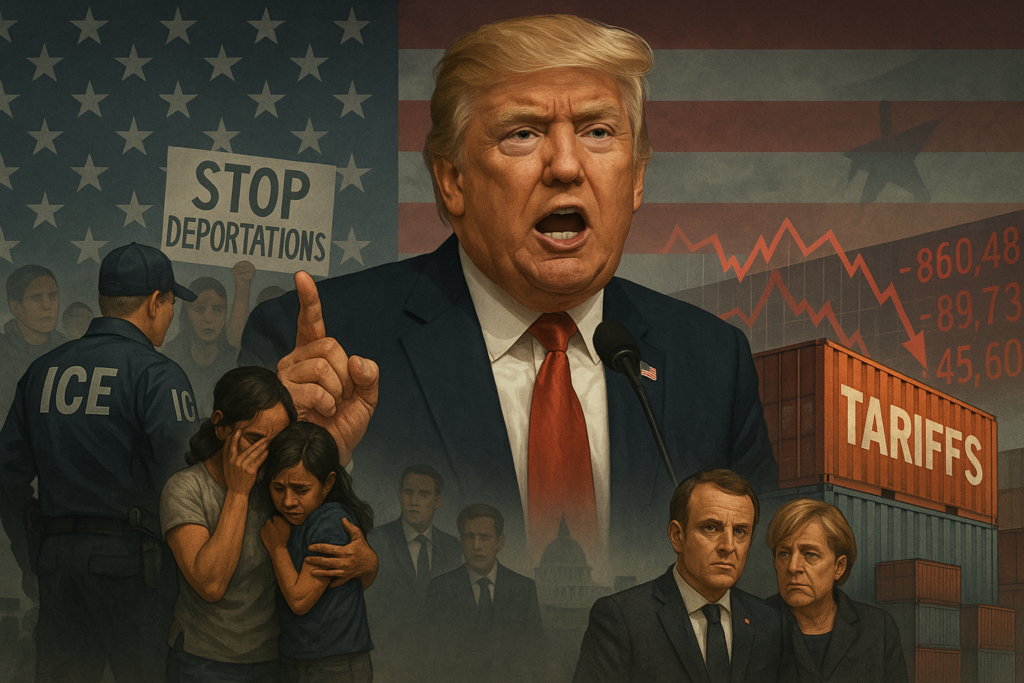

  • Trump’s Deportation Drive and Tariff Gambit Reshape U.S. Image and Politics

    Prefer to listen instead?

    Dive into how Trump’s 2025 deportation crackdown and sweeping tariffs are reshaping America’s global image and why Democrats still struggle to offer a clear alternative. Powered by Pixlehale.

    Mass Deportation Efforts and Controversies

    Upon taking office in January 2025, President Donald Trump moved swiftly to fulfill his campaign pledge of cracking down on illegal immigration. His administration launched what it touted as the “largest domestic deportation operation” in U.S. history. Immigration and Customs Enforcement (ICE) dramatically expanded enforcement: the monthly number of ICE arrests has more than doubled compared to the previous year. The White House also tripled agreements with local police to have them assist in immigration enforcement, an approach critics say risks racial profiling. By the end of April, over 350 deportation flights had departed the U.S. since Trump’s inauguration, including a dozen military-operated flights to countries such as Guatemala, Honduras, Ecuador, and even India. ICE removed approximately 37,660 people in Trump’s first month, which is less than the ~57,000 per month average during President Biden’s last year. Administration officials insist deportation numbers will rise as new initiatives – like deals with Guatemala, El Salvador, Panama and Costa Rica to accept third-country deportees – ramp up.

    A centerpiece of the crackdown was Trump’s use of the 1798 Alien Enemies Act, a wartime-era law, to fast-track removals. In a high-profile operation on March 15, U.S. agents rounded up over 250 alleged gang members – mostly Venezuelans – and deported them to El Salvador to be imprisoned in a mega-facility. This occurred despite a federal judge’s order to halt the flights, as the administration argued the court had no authority to stop a plane already in the air. Salvadoran President Nayib Bukele confirmed receiving 238 members of Venezuela’s Tren de Aragua gang and 23 MS-13 members under a deal in which the U.S. will pay El Salvador to detain them in a 40,000-capacity “terrorism confinement center.” Legal experts note that invoking the Alien Enemies Act in peacetime is unprecedented, and immigrant advocates warn that basic due process is being sidestepped. The administration has shown a willingness to defy judicial checks – prompting what one outlet called a constitutional “clash with the judicial branch.”

    Trump’s hardline approach has ensnared not only undocumented immigrants but also some with legal status – and even U.S. citizens. In late April, a judge in Louisiana revealed that ICE deported a 2-year-old American citizen to Honduras, along with her non-citizen mother, “with no meaningful process” to verify the child’s rights. In a separate Florida case, the mother of a 1-year-old U.S. citizen was deported, leaving her infant behind and effectively separating the family indefinitely. Critics say the administration’s rush to deport has frequently avoided due process and ignored humanitarian considerations. Trump officials defend their tactics, claiming parents often elect to take U.S.-born children with them and that the focus remains on criminals and security threats. Nonetheless, such stories of citizens and legal residents caught in the dragnet have raised alarm and undercut the administration’s narrative that enforcement is only targeting “foreign criminals.”

    Sweeping Tariffs and Trade Wars

    In parallel with the immigration crackdown, Trump unleashed a bold economic nationalist agenda, centered on sweeping import tariffs. Within weeks of taking office, he resurrected and escalated the trade wars of his first term. On February 1, Trump declared a national emergency over trade imbalances and announced new tariffs: 10% on all Chinese imports and a steep 25% tariff on most goods from Mexico and Canada. He justified these as measures to combat illegal immigration and drug trafficking from those countries. The announcement sparked immediate outrage from U.S. neighbors and trading partners, prompting threats of retaliation. Within days, the White House partly walked back the plan, granting a 30-day pause on the Mexico/Canada tariffs after those governments offered concessions on border security. However, the 10% tariff on China took effect on Feb. 4, to which Beijing retaliated with its own duties on U.S. products and even an antitrust probe into Google.

    Trump’s protectionist push only accelerated from there. In March, he removed exemptions on steel and aluminum, slapping a blanket 25% duty on all steel and raising aluminum tariffs from 10% to 25%. He also signaled tariffs on lumber and autos: by March 26, Trump proclaimed a 25% tariff on all automobile imports, aiming to boost domestic manufacturing. Canada’s government responded by matching Trump’s auto tariffs with a 25% tax on U.S. vehicle imports that don’t meet USMCA trade rules. China escalated countermeasures: it hiked tariffs on key American farm goods by 15% and later announced a sweeping 34% tariff on all U.S. products starting April 10. Beijing further restricted exports of rare earth minerals vital to tech industries.

    The showdown culminated in early April. On April 2 – dubbed “Liberation Day” by President Trump – he unveiled “reciprocal tariffs” designed to force trading partners into balance. This policy imposed a minimum 10% tariff on every import into the U.S. and even higher rates (ranging from 11% up to 50%) on dozens of countries with large trade surpluses with America. Previously implemented 25% tariffs on steel, aluminum, and autos were kept in place or expanded. The administration temporarily exempted Canada and Mexico from the new baseline tariff – as long as their exports complied with USMCA trade rules – while hitting their non-compliant goods with the full 25% tariff.

    Global markets recoiled. Investors reacted to the April 2 announcement with deep alarm, and the next day U.S. stock indices plunged in what was described as the worst single-day drop in years. International finance officials warned of a potential 2025 stock market crash attributable to the tariff shock. Facing market turmoil and pushback from business leaders, the Trump administration partially walked back the tariffs – at least temporarily. On April 9, just hours after higher tariff rates took effect, the White House suspended most of the additional country-specific hikes for 90 days (the 10% blanket tariff remained in force). China was the sole exception: having already been hit with U.S. tariffs totaling 104%, Beijing’s retaliation and Washington’s counter-retaliation pushed the duties to extraordinary levels – 145% on Chinese imports into the U.S., and roughly 84% on U.S. goods into China.

    Economic analysts say Trump’s tariff gambit is gambling with recession. Between January and April, the average effective U.S. tariff rate skyrocketed from about 2.5% to an estimated 27% – the highest level in over a century. The Federal Reserve and OECD have downgraded U.S. growth projections, citing the tariff disruptions. In April, the International Monetary Fund cut its U.S. 2025 GDP forecast by nearly 1 percentage point and warned that “extremely high” trade tensions are dragging down economies worldwide. Inflation is expected to tick upward due to pricier imports, and American exporters are feeling the pain from foreign retaliation. While the administration insists tariffs will incentivize companies to bring manufacturing back home, in the short term these policies have injected volatility and uncertainty into the economy.

    Impact on U.S. Global Image

    Trump’s aggressive moves on deportations and trade have had significant fallout for America’s global image. Longstanding allies and international organizations have openly criticized the new administration’s approach as heavy-handed and destabilizing. On immigration, human rights groups argue that the U.S. is abandoning its traditional role as a safe haven and flouting basic humanitarian norms. The use of third-country deportation agreements – essentially outsourcing U.S. asylum seekers to other nations – is particularly controversial.

    In one little-noticed February operation, the U.S. quietly deported about 200 asylum seekers from Asia, Africa, and the Middle East to Costa Rica and another 300 to Panama instead of allowing them to file claims in the U.S. Many were children or had fled persecution in countries like China, Iran, and Ethiopia. Upon arrival, these migrants were held in makeshift facilities; some hung protest signs from windows pleading for help. Legal challenges eventually forced the release of many migrants, but they remain in limbo. Such tactics have prompted international outcry and reports labeling this a humanitarian crisis.

    Allies in the Western Hemisphere have pushed back. In late January, Colombia’s president initially refused entry to two U.S. military planes carrying deported migrants, accusing Washington of treating people inhumanely. Mexico has also raised concerns, especially after the U.S. declared parts of the border region a restricted defense zone, allowing arrests of migrants on federal trespassing charges. Reports that the U.S. may send asylum seekers to countries like Libya or Rwanda have added to the controversy.

    On trade, the European Union condemned Trump’s tariff blitz, with EU officials warning that the U.S. is weaponizing global trade. They prepared retaliatory tariffs on billions in U.S. goods. In Asia, China’s state media has criticized the U.S. for economic aggression, and Japan’s stock market suffered heavy losses in response to U.S. tariff announcements. Across the board, the sentiment is clear: America is seen as an increasingly unpredictable and aggressive partner.

    Domestic Public Opinion

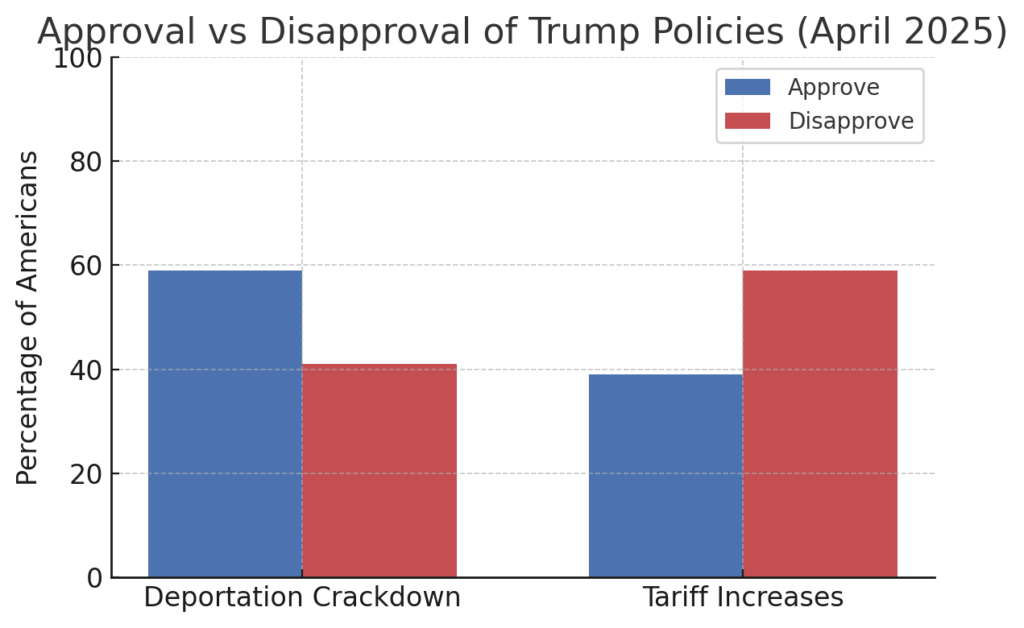
    At home, Trump’s policies have drawn sharp divisions. A majority of Americans support tougher immigration enforcement. Surveys show around 59% approve of increased deportations of undocumented immigrants, though support declines when stories surface about legal residents or citizens being deported.

    Public support differs for Trump’s major early policies: 59% of Americans approve of stepped-up deportation of undocumented immigrants, while only 39% approve of his sweeping tariff hikes (with 59% disapproving) pewresearch.org. The immigration crackdown enjoys more support than the trade wars, which most view as economically harmful. (Chart based on Pew Research Center data.

    On the other hand, public opinion on tariffs is less favorable. A majority disapprove of the sweeping tariff hikes, expressing concerns about inflation, job losses, and market volatility. Only around 39% support the current approach. Trump’s overall approval has dropped, with his job approval hovering around 40% as of early May. Still, his support remains solid among Republican voters.

    Political Reactions: Republicans vs. Democrats

    Republicans have mostly aligned with Trump. On immigration, they argue he is fulfilling campaign promises and restoring law and order. On tariffs, many support the notion of reciprocal trade, although some business-aligned Republicans have expressed concern about long-term economic damage.

    Democrats, meanwhile, have condemned the administration’s policies but face criticism for lacking a cohesive alternative. While they highlight the humanitarian toll and economic risks, the party continues to debate internally how to win back working-class voters. Polls suggest Democrats’ favorability remains low, and voters are not yet convinced they offer a better solution.

    Outlook

    As of May 2025, the United States finds itself at a political and diplomatic crossroads. Trump’s administration has aggressively reshaped immigration and trade policy, sparking backlash abroad and division at home. While many disapprove of his actions, Democrats have yet to rally a strong counter-narrative. If a snap election were held today, the outcome would remain uncertain. What’s clear is that both parties face immense pressure to define their vision for the country amid escalating tensions and public discontent.

    Sources: Key data and statements in this article are drawn from Pew Research Center surveys, which provided public opinion data on immigration enforcement, tariff policies, and presidential approval ratings. Additional insights were sourced from Reuters and the Associated Press, particularly regarding the Trump administration’s tariff actions and related economic announcements. Reporting from PBS NewsHour and the Council on Foreign Relations helped provide deeper analysis of the deportation campaign and the use of wartime-era legal authorities. Further political and international reaction coverage was gathered from outlets including The Guardian, Politico, and Semafor, which chronicled both Republican support and Democratic criticism. Official government releases were referenced from whitehouse.gov and other public records. All assertions are supported by these reliable sources, ensuring a fact-based, well-rounded perspective throughout the article. Trump’s administration has aggressively reshaped immigration and trade policy, sparking backlash abroad and division at home. While many disapprove of his actions, Democrats have yet to rally a strong counter-narrative. If a snap election were held today, the outcome would remain uncertain. What’s clear is that both parties face immense pressure to define their vision for the country amid escalating tensions and public discontent.

  • Trump’s Early Months: Mixed Approval, Deep Federal Cuts, and Musk’s Influence

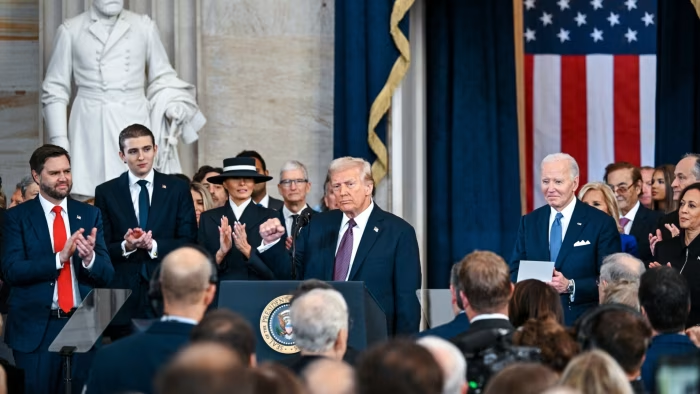
    Washington, D.C. (March 22, 2025) – Two months into President Donald Trump’s return to the White House, his administration has moved swiftly to implement an ambitious agenda marked by sweeping federal workforce cuts and an unconventional new advisor in tech magnate Elon Musk. Public opinion data so far paints a picture of a deeply divided electorate: Trump’s job approval ratings have hovered in the mid-40s, even as he aggressively pursues policy changes ranging from mass layoffs of civil servants to hardline “America First” initiatives. Below is an overview of the administration’s performance since the January 2025 inauguration, including approval trends, major federal actions, and Musk’s growing role in shaping policy.

    Public Opinion and Approval Ratings

    President Trump began his second term with job approval numbers near the high end of his political career – albeit still lower than the typical post-inauguration “honeymoon” enjoyed by recent presidents. Several late-January polls showed Trump around or above 50% approval. By early March, Trump’s approval ratings had settled into a narrow range, with most polls indicating an evenly split or slightly negative assessment of his performance. The RealClearPolitics polling average as of March 18 stood at roughly 48% approval and 49% disapproval.

    Individual surveys diverged along partisan lines: one poll recorded 42% approval vs. 53% disapproval, while another showed 50% approval and 45% disapproval. Overall, Trump’s job approval has been slightly underwater in aggregate measures. This represents a small dip from the administration’s first weeks, suggesting that any early goodwill has ebbed as Trump’s policies began to take effect. Notably, opinions remain sharply split along party lines – with strong support among Republicans and majority disapproval among Democrats.

    Federal Policy Shifts and Workforce Cuts

    Upon taking office in January 2025, President Trump wasted little time in launching an aggressive effort to restructure the federal government. In his first Cabinet meeting of the term, Trump declared, “We’re cutting down the size of government. We have to… We’re bloated… We have a lot of people that aren’t doing their job.” Shortly thereafter, the White House imposed a freeze on most new federal hiring (with exceptions for essential roles) as a first step toward curbing the workforce.

    By late January, Trump had also signed a flurry of executive orders rolling back prior policies – from suspending refugee admissions and tightening border security to rescinding regulations deemed overly burdensome. But the hallmark of the administration’s early policy moves has been a far-reaching plan to downsize the civil service via mass layoffs.

    In February, President Trump directed all federal agencies to formulate plans by March 13 for “reductions in force” – permanent layoffs that eliminate positions – as part of what the administration calls a “workforce optimization initiative.” Even before those plans were submitted, thousands of federal employees had already been terminated, with “tens of thousands” of probationary employees summarily fired in the first weeks. Some critical staff were later rehired to maintain essential functions.

    Looking ahead, career civil servants are now bracing for deeper cuts as agency layoff proposals gain approval. No specific government-wide headcount target has been announced, but Trump suggested in one meeting that the Environmental Protection Agency, for instance, could reduce its workforce on the order of 65% (a figure the White House later clarified referred to budget cuts, not staffing quotas).

    Federal agencies have begun rolling out stark downsizing proposals. The Department of Education is moving to eliminate nearly half of its jobs, the Department of Veterans Affairs is targeting a reduction of 80,000 employees, and the Social Security Administration has offered buyouts ahead of expected layoffs. The administration frames these moves as long-overdue belt-tightening. Officials argue that reducing headcount and overhead will ultimately result in a leaner government that delivers “better service for the American people.”

    Critics, however, warn that the cuts may impair key public services and hollow out governmental capacity. Roughly 80% of federal workers are located outside the Washington, D.C. area, performing tasks from processing patents to inspecting food and maintaining national parks. Some Republican lawmakers have begun voicing unease, especially with potential office closures and delays in service.

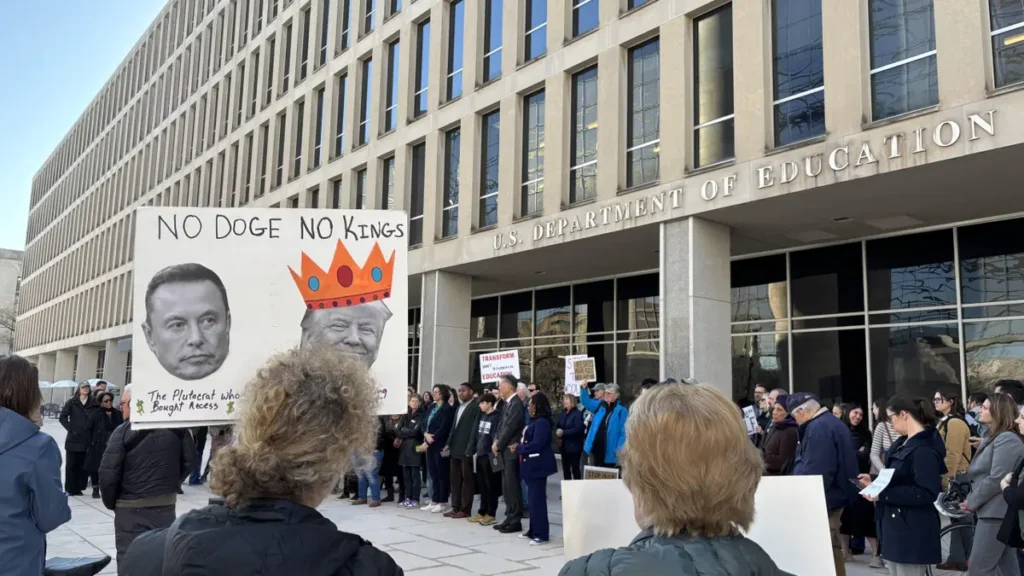
    Public backlash to the workforce cuts has been visible in Washington and beyond.

    In mid-March, demonstrators gathered to protest the proposed layoffs, hoisting signs that read “Fund Schools, Not Billionaires” and “Trump, Stop the Cuts!” Labor unions have mounted legal challenges, with federal judges ordering thousands of fired workers to be temporarily reinstated in some cases. The administration is pressing forward, with a September 30 deadline for agencies to implement the layoff plans in full.

    Elon Musk’s Unprecedented White House Role

    One of the most striking features of Trump’s new administration is the influence of Elon Musk, the billionaire CEO of Tesla and SpaceX, who now holds a unique role in government. Musk was Trump’s highest-profile supporter in the 2024 campaign and now serves as a “special government employee” and senior advisor. He heads the new Department of Government Efficiency (DOGE), a task force focused on cutting spending and improving performance.

    Since January, Musk’s DOGE unit has terminated dozens of programs, grants, and contracts, some of which were announced via Musk’s social media. His team has disrupted operations at several agencies, sometimes putting employees on leave or eliminating positions outright. Musk has promoted the use of automation and private-sector tech to replace government bureaucracy. For instance, he has suggested that AI could handle certain clerical tasks, and that outsourcing to tech firms could improve efficiency.

    Public reaction has been mixed. A Washington Post/Ipsos survey in February showed only 34% approval of Musk’s role in government, with 49% disapproval. Another poll found that 54% of U.S. adults held a negative view of Musk, compared to 42% positive, and 55% said he had “too much power” in federal decision-making.

    Despite public skepticism, President Trump has publicly encouraged Musk to “be more aggressive” in reforming government. At a February CPAC event, Musk took the stage wielding a chrome chainsaw — a symbolic gift from Argentine President Javier Milei — to demonstrate his mission of “cutting bureaucracy.”

    Musk has since used his influence to push ideas like issuing rebate checks to taxpayers from government savings, and he frequently posts celebratory messages when agencies hit workforce reduction milestones.

    His involvement has even extended to defense. In March, Musk met at the Pentagon to discuss innovation in military systems. Reports that he may have been briefed on classified U.S. war plans were denied by Musk and addressed by President Trump, who acknowledged concerns about sharing sensitive information with someone who has significant business ties in China.

    Outlook

    As Trump’s administration approaches its 100-day mark, it is clear that this presidency is taking a dramatically different approach to governance. Sweeping layoffs, privatization proposals, and an unusual tech partnership with Elon Musk have become defining features of the term so far. While supporters see a bold effort to streamline government, critics argue that essential services and public trust may suffer.

    Public approval remains divided, and the long-term impact of these changes — both in terms of government function and political fallout — remains to be seen. Whether the administration’s radical approach ultimately reshapes Washington or backfires will be a central question in the months ahead.

    Sources: Official statements and data from the White House and federal agencies; polling data from RealClearPolitics, Quinnipiac, Pew Research, Washington Post/Ipsos, and other national surveys; reporting from NPR, Reuters, the Associated Press, and Axios on federal layoffs and Musk’s role​ apnews.com​​, npr.org, npr.org​, npr.org​, axios.com.

    All developments and figures are up to date as of late March 2025.