
Prefer to listen instead?
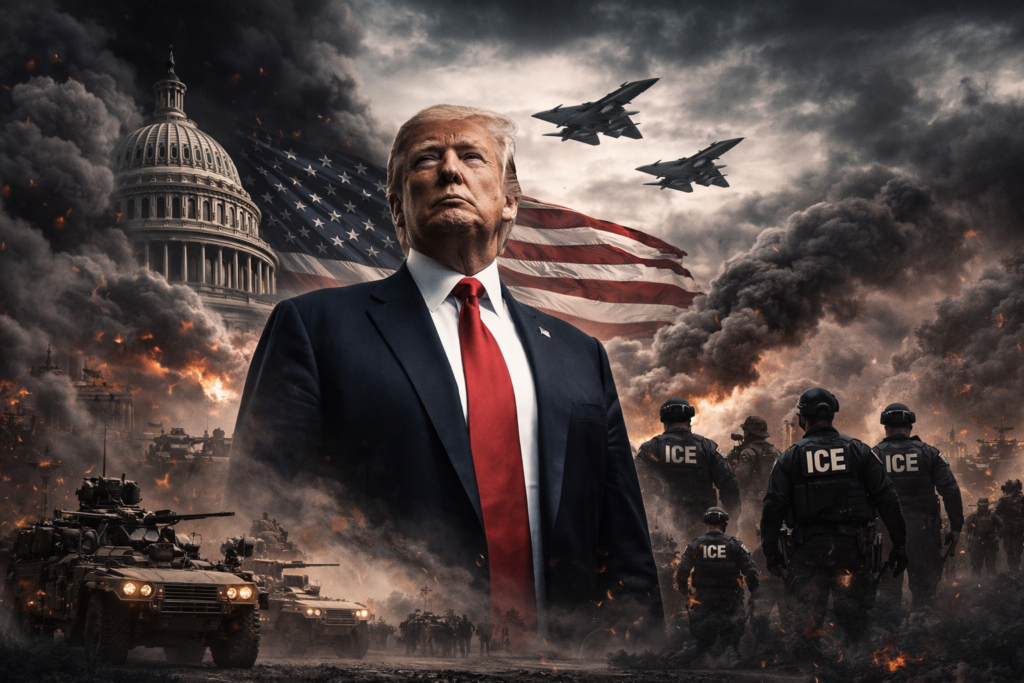
From Washington to the world stage, Trump’s second phase is shifting the balance of power. Here’s what’s happening and why it matters. Powered by PixleHale.
When the Trump administration returned to power, its opening strategy was clear: move fast, cut deep, and disrupt the federal system from within. Agencies were downsized, budgets were slashed, and an unconventional alignment with private-sector figures—most visibly Elon Musk—signaled a new governing philosophy. In the early months, it was framed as reform. One year later, it looks more like transformation: not only of government structure, but of power itself.
The argument, from the beginning, was that the federal state was bloated—too slow, too expensive, too insulated from performance and consequence. The remedy was managerial: reduce headcount, consolidate functions, automate where possible, and centralize “efficiency” inside a new apparatus intended to do what Congress and agencies, in this view, would not do for themselves.
But governing is never just management. It is also coercion, legitimacy, and the daily burden of proof: can the state still deliver what the public expects—safety, services, stability—after it has been deliberately thinned?
A smaller workforce, a larger wager
By the end of 2025, the scale of the reduction was no longer theoretical. Analyses of government data found a net decline on the order of hundreds of thousands of positions—an unusual contraction for a modern federal workforce whose obligations remain fixed by law and by crisis.
The numbers vary by measurement window and dataset, but the direction is consistent: separations soared while hiring dropped, and younger, newer employees were hit hardest—suggesting a system that shed not only “bureaucracy,” but the very pipeline that renews institutional memory.
The downstream effects have appeared unevenly—because government is uneven. Some offices, facing statutory deadlines or operational risk, rehired quickly. Others simply slowed. Service problems do not always arrive as a single collapse; they arrive as a widening queue: longer wait times, fewer inspectors, slower processing, more unanswered calls.
And the impact has not been contained to Washington. In the D.C. region alone, local economic reporting tied job losses and reduced pay to fiscal planning worries—less income-tax revenue, less consumer spending, and the quiet erosion of what had long been the city’s stabilizing economic sector.
The most consequential policy question is not whether government can be made smaller. It is whether, in practice, it can be made smaller without becoming brittle—unable to absorb shocks without improvisation, exceptions, or emergency workarounds that contradict the original logic of “efficiency.”
Enforcement comes home
While the government cut inward, it also expanded outward—most visibly through immigration enforcement. And on that front, the story has been less about spreadsheets than about streets: raids, protests, clashes over authority, and in several cases, deadly force.
Nowhere symbolized that collision more than Minneapolis. A large enforcement surge brought thousands of agents into the region and produced thousands of arrests, according to ICE. But it also produced a secondary economy of fear: families who stopped going to work, patients who missed medical appointments, students who disappeared from classrooms—spreading the consequences far beyond the individuals ICE was trying to identify and remove.

The surge became nationally defining after two U.S. citizens were killed in shootings involving federal immigration agents. Federal and local accounts have repeatedly diverged, with local officials pointing to video evidence they say undermines federal claims of self-defense.
The pattern extended beyond Minnesota. In South Texas, the killing of U.S. citizen Ruben Ray Martinez in March 2025 drew little attention until records litigation and reporting revealed the federal role and raised questions about disclosure and narrative control.
Alongside shootings, deaths in custody became another pressure point. Reporting on individual cases—like the death of an Afghan immigrant shortly after intake—has been paired with broader allegations from lawmakers and advocates that rapid detention expansion is straining medical care and oversight, while DHS insists its screening and care processes remain adequate.
The deeper question, for the administration and for the country, is what this enforcement model produces when scaled: whether it can be aggressive without becoming indiscriminate, and whether the state can intensify coercion while also maintaining broad public legitimacy for how that coercion is used.
War abroad, consequences at home
If domestic policy is now defined by contraction and enforcement, foreign policy has been defined by escalation.
The U.S.-Israeli war with Iran—launched February 28 and described by U.S. Central Command as “Operation Epic Fury”—shifted the administration’s second year into a different register: major combat operations, contested maritime corridors, and a rapidly tightening link between military decisions and the price of daily life.
The administration has publicly described objectives in stark terms, while reporting captured frequent changes in messaging around end-state and timeline—an inconsistency that critics cite as evidence of poor planning and supporters frame as flexibility in war.
Operational metrics underscore intensity: by mid-March, U.S. Central Command reported 7,800+ targets struck and 120+ Iranian vessels damaged or destroyed, alongside thousands of combat flights.
And the war’s domestic impact is not abstract. Reuters/Ipsos polling reported that a majority of Americans say higher gasoline prices are already hitting household finances, and that the cost of living—long a central political vulnerability—has become even more exposed in wartime conditions.
Congress, meanwhile, has revived an old constitutional argument: who decides when “major combat operations” become war—and how long a president can sustain hostilities without explicit authorization. That debate has sharpened as lawmakers attempt, and fail, to constrain executive war powers through War Powers Resolution mechanisms.
Venezuela and Cuba: oil, leverage, and a hemispheric playbook
The throughline between domestic enforcement and foreign escalation is not only ideology. It is also leverage.
In Venezuela, the administration executed a high-profile capture operation against Nicolás Maduro and quickly pivoted toward managing oil supply in ways that appear calibrated to global energy pressures—authorizing certain transactions involving PDVSA while keeping payments and legal frameworks tied to U.S. oversight.
The diplomatic reset is visible: the U.S. flag has been raised again at the embassy in Caracas, seven years after its lowering—symbolic theater, but also a signal that the U.S. is building a new relationship with whoever holds power in Venezuela now.
Cuba has been treated differently: not as a partner to manage, but as a regime to squeeze. Reporting from Reuters and Time described an effective fuel blockade that has contributed to blackouts and humanitarian stress, while talks proceed under extraordinary pressure and Cuban officials reject U.S. demands that touch leadership succession.
The rhetoric has been blunt enough to become its own story. Trump has publicly described the possibility of “taking” Cuba, while U.S. officials emphasize “deals” and Cuban leaders frame the policy as an attempt to force surrender through economic suffocation.
The shape of the era
Taken together, the past year suggests a presidency moving on two tracks at once: shrinking the administrative state while expanding the coercive state—more capacity to compel, less capacity to serve. That is a volatile combination, because legitimacy depends on both.
Supporters see coherence in the approach: a government that enforces borders, acts decisively abroad, and refuses to subsidize institutions it deems inefficient. Critics see overreach: executive power expanding faster than oversight, and a thin state that can still punish but struggles to deliver. Polling suggests the country remains polarized, with rising unease on cost-of-living pressures and limited public appetite for escalatory ground-war scenarios.
What happens next will not be decided by rhetoric alone. It will be decided by outcomes: whether services degrade, whether courts constrain, whether wars widen, whether markets punish, and whether communities accept the tradeoffs a sharper enforcement state requires.
Sources: Key insights and framing in this article are informed by reporting and analysis from major national and international outlets, including Pew Research Center, which provided context on public opinion trends and political polarization, as well as coverage from Reuters and Associated Press on federal policy developments, international conflicts, and economic signals tied to the administration’s actions. Additional analysis was drawn from PBS NewsHour and the Council on Foreign Relations, particularly regarding geopolitical dynamics involving Iran and Latin America, while reporting from The Guardian, Politico, and Semafor helped capture political reactions, legal developments, and evolving narratives across party lines. Additional context on immigration enforcement and federal restructuring was informed by publicly available reporting, official government statements, and releases from The White House and other federal records. This article was produced by PixleHale and its editorial contributors, with all interpretations based on a synthesis of these sources to provide a balanced and comprehensive perspective.