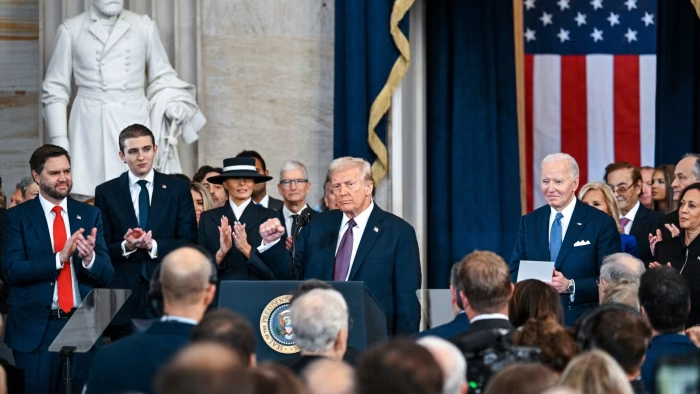
Washington, D.C. (March 22, 2025) – Two months into President Donald Trump’s return to the White House, his administration has moved swiftly to implement an ambitious agenda marked by sweeping federal workforce cuts and an unconventional new advisor in tech magnate Elon Musk. Public opinion data so far paints a picture of a deeply divided electorate: Trump’s job approval ratings have hovered in the mid-40s, even as he aggressively pursues policy changes ranging from mass layoffs of civil servants to hardline “America First” initiatives. Below is an overview of the administration’s performance since the January 2025 inauguration, including approval trends, major federal actions, and Musk’s growing role in shaping policy.
Public Opinion and Approval Ratings
President Trump began his second term with job approval numbers near the high end of his political career – albeit still lower than the typical post-inauguration “honeymoon” enjoyed by recent presidents. Several late-January polls showed Trump around or above 50% approval. By early March, Trump’s approval ratings had settled into a narrow range, with most polls indicating an evenly split or slightly negative assessment of his performance. The RealClearPolitics polling average as of March 18 stood at roughly 48% approval and 49% disapproval.
Individual surveys diverged along partisan lines: one poll recorded 42% approval vs. 53% disapproval, while another showed 50% approval and 45% disapproval. Overall, Trump’s job approval has been slightly underwater in aggregate measures. This represents a small dip from the administration’s first weeks, suggesting that any early goodwill has ebbed as Trump’s policies began to take effect. Notably, opinions remain sharply split along party lines – with strong support among Republicans and majority disapproval among Democrats.
Federal Policy Shifts and Workforce Cuts
Upon taking office in January 2025, President Trump wasted little time in launching an aggressive effort to restructure the federal government. In his first Cabinet meeting of the term, Trump declared, “We’re cutting down the size of government. We have to… We’re bloated… We have a lot of people that aren’t doing their job.” Shortly thereafter, the White House imposed a freeze on most new federal hiring (with exceptions for essential roles) as a first step toward curbing the workforce.
By late January, Trump had also signed a flurry of executive orders rolling back prior policies – from suspending refugee admissions and tightening border security to rescinding regulations deemed overly burdensome. But the hallmark of the administration’s early policy moves has been a far-reaching plan to downsize the civil service via mass layoffs.
In February, President Trump directed all federal agencies to formulate plans by March 13 for “reductions in force” – permanent layoffs that eliminate positions – as part of what the administration calls a “workforce optimization initiative.” Even before those plans were submitted, thousands of federal employees had already been terminated, with “tens of thousands” of probationary employees summarily fired in the first weeks. Some critical staff were later rehired to maintain essential functions.
Looking ahead, career civil servants are now bracing for deeper cuts as agency layoff proposals gain approval. No specific government-wide headcount target has been announced, but Trump suggested in one meeting that the Environmental Protection Agency, for instance, could reduce its workforce on the order of 65% (a figure the White House later clarified referred to budget cuts, not staffing quotas).
Federal agencies have begun rolling out stark downsizing proposals. The Department of Education is moving to eliminate nearly half of its jobs, the Department of Veterans Affairs is targeting a reduction of 80,000 employees, and the Social Security Administration has offered buyouts ahead of expected layoffs. The administration frames these moves as long-overdue belt-tightening. Officials argue that reducing headcount and overhead will ultimately result in a leaner government that delivers “better service for the American people.”
Critics, however, warn that the cuts may impair key public services and hollow out governmental capacity. Roughly 80% of federal workers are located outside the Washington, D.C. area, performing tasks from processing patents to inspecting food and maintaining national parks. Some Republican lawmakers have begun voicing unease, especially with potential office closures and delays in service.
Public backlash to the workforce cuts has been visible in Washington and beyond.
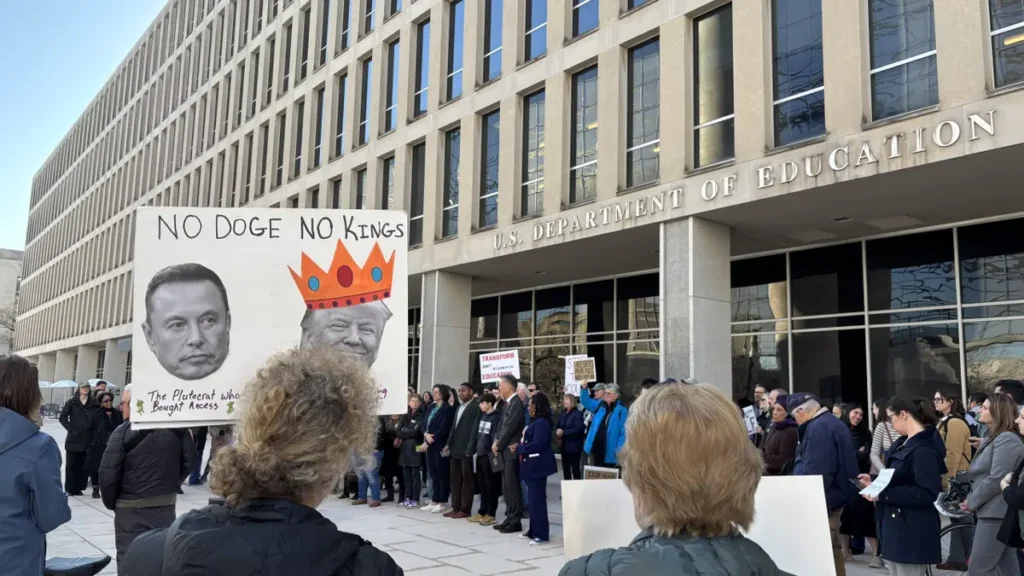
In mid-March, demonstrators gathered to protest the proposed layoffs, hoisting signs that read “Fund Schools, Not Billionaires” and “Trump, Stop the Cuts!” Labor unions have mounted legal challenges, with federal judges ordering thousands of fired workers to be temporarily reinstated in some cases. The administration is pressing forward, with a September 30 deadline for agencies to implement the layoff plans in full.
Elon Musk’s Unprecedented White House Role
One of the most striking features of Trump’s new administration is the influence of Elon Musk, the billionaire CEO of Tesla and SpaceX, who now holds a unique role in government. Musk was Trump’s highest-profile supporter in the 2024 campaign and now serves as a “special government employee” and senior advisor. He heads the new Department of Government Efficiency (DOGE), a task force focused on cutting spending and improving performance.
Since January, Musk’s DOGE unit has terminated dozens of programs, grants, and contracts, some of which were announced via Musk’s social media. His team has disrupted operations at several agencies, sometimes putting employees on leave or eliminating positions outright. Musk has promoted the use of automation and private-sector tech to replace government bureaucracy. For instance, he has suggested that AI could handle certain clerical tasks, and that outsourcing to tech firms could improve efficiency.
Public reaction has been mixed. A Washington Post/Ipsos survey in February showed only 34% approval of Musk’s role in government, with 49% disapproval. Another poll found that 54% of U.S. adults held a negative view of Musk, compared to 42% positive, and 55% said he had “too much power” in federal decision-making.
Despite public skepticism, President Trump has publicly encouraged Musk to “be more aggressive” in reforming government. At a February CPAC event, Musk took the stage wielding a chrome chainsaw — a symbolic gift from Argentine President Javier Milei — to demonstrate his mission of “cutting bureaucracy.”

Musk has since used his influence to push ideas like issuing rebate checks to taxpayers from government savings, and he frequently posts celebratory messages when agencies hit workforce reduction milestones.
His involvement has even extended to defense. In March, Musk met at the Pentagon to discuss innovation in military systems. Reports that he may have been briefed on classified U.S. war plans were denied by Musk and addressed by President Trump, who acknowledged concerns about sharing sensitive information with someone who has significant business ties in China.
Outlook
As Trump’s administration approaches its 100-day mark, it is clear that this presidency is taking a dramatically different approach to governance. Sweeping layoffs, privatization proposals, and an unusual tech partnership with Elon Musk have become defining features of the term so far. While supporters see a bold effort to streamline government, critics argue that essential services and public trust may suffer.
Public approval remains divided, and the long-term impact of these changes — both in terms of government function and political fallout — remains to be seen. Whether the administration’s radical approach ultimately reshapes Washington or backfires will be a central question in the months ahead.
Sources: Official statements and data from the White House and federal agencies; polling data from RealClearPolitics, Quinnipiac, Pew Research, Washington Post/Ipsos, and other national surveys; reporting from NPR, Reuters, the Associated Press, and Axios on federal layoffs and Musk’s role apnews.com, npr.org, npr.org, npr.org, axios.com.
All developments and figures are up to date as of late March 2025.