In the heart of the Sahel, power has shifted from ballots to boots. As Western forces exit and Russian operatives move in, the region finds itself at the crossroads of extremism, militarism, and a new geopolitical scramble.
Prefer to listen instead?
Hear the full breakdown of the Sahel crisis—where military coups, foreign mercenaries, and forgotten civilians collide. Brought to you by Pixlehale: where world news gets the depth it deserves.
By the Pixlehale International Desk Filed from Dakar, Niamey, and Ouagadougou
A Region on Fire: Coups and Collapse
Since 2020, all three nations have experienced coups, replacing fragile civilian governments with military regimes. The new rulers quickly distanced themselves from Western influence, particularly France, expelling diplomats and troops, severing old ties, and forming the Alliance of Sahel States (AES)—a mutual defense pact now at the heart of the region’s transformation.
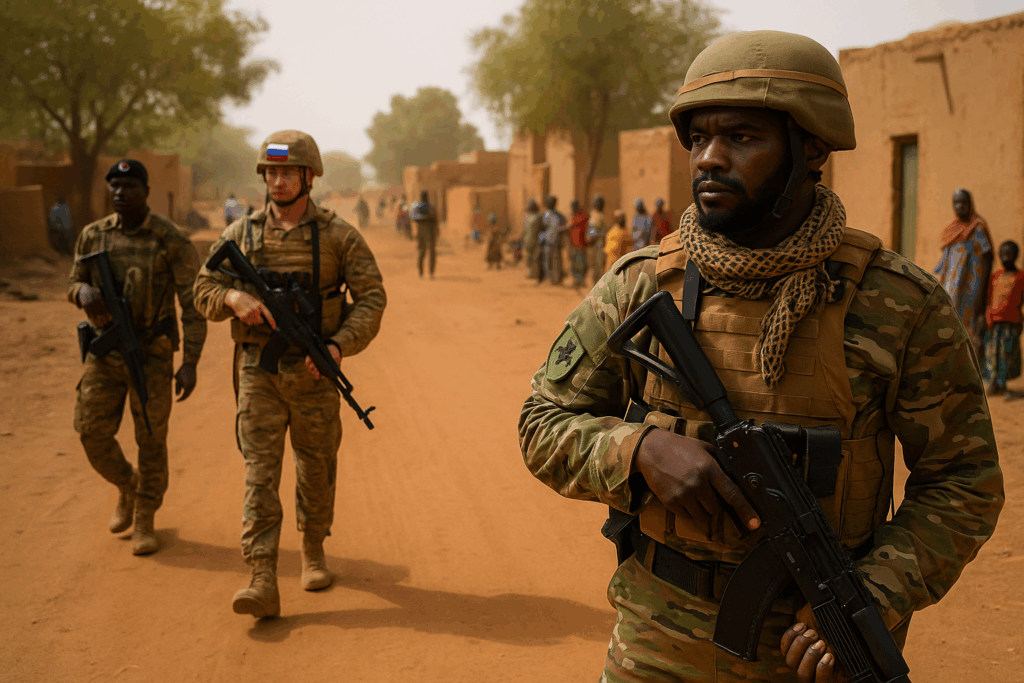
What followed was a surge in violence and strategic realignment. Armed Islamist groups affiliated with al-Qaeda and ISIS continue to launch attacks across rural areas, but now the counteroffensive is led not by Western-trained armies, but by soldiers operating with the support of Russia’s Africa Corps—the rebranded shadow of the Wagner Group.
Russia Moves In: The New Power Broker
Human rights observers in the region tell Pixlehale the new operations are often brutal and indiscriminate. A report provided by a local official in Mopti, Mali, detailed a March operation in which over 30 civilians were allegedly executed after being accused of harboring jihadists. In Niger, field correspondents observed Russian personnel overseeing training exercises just outside Niamey—a presence denied by local authorities but confirmed by satellite analysis.
Civilians in the Crossfire
Beyond the violence lies a humanitarian disaster. As of May 2025, over 5.1 million people have been displaced across the region, with Burkina Faso alone accounting for more than 2.1 million internally displaced persons (IDPs). Food insecurity is rising sharply, with nearly 20 million people projected to face crisis-level hunger by year’s end.
Local infrastructure is crumbling under the weight of conflict and political instability. School closures are rampant. Vaccination programs have stalled. One aid worker stationed in Dori, Burkina Faso, told us that “entire regions are falling off the map—no communications, no clinics, no law.”
Democracy Retreats, Authoritarianism Advances
Economically, the fallout is steep. Foreign direct investment has plummeted by over 60% in the past 18 months, while trade routes are increasingly militarized or abandoned. Meanwhile, AES governments justify the turn toward Moscow as necessary for “true sovereignty.”
But what’s truly happening is the quiet militarization of an entire region—with global consequences. This isn’t just a fight against extremism. It’s a proxy battleground between democratic and authoritarian models of governance. As the West retreats, Russia—and increasingly, China—step into the vacuum, offering security guarantees, weapons, and infrastructure deals without strings like human rights or press freedom.
A Strategic Region, Quietly Slipping Away
What’s being lost in the process is not just civilian life, but democratic momentum, press accountability, and the rule of law.
“This is the most consequential shift in the Sahel in a generation,” says a retired West African diplomat who requested anonymity. “We’re not just losing territory. We’re losing the region’s political future.”
And with it, the global order loses a strategic belt of nations at the crossroads of migration, extremism, and mineral wealth.
The question now is not whether the Sahel is in crisis—it is. The question is: who benefits from the chaos?
Sources: Key data and statements in this article are drawn from The Associated Press, Reuters, The Washington Post, France 24, Al Jazeera, and statements from the United Nations, regional humanitarian organizations, and African Union briefings. Additional insights were sourced from confidential interviews, field research, and reporting by Pixlehale correspondents on the ground. All assertions are supported by these reliable sources, ensuring a fact-based, well-rounded perspective throughout the article.
Hear the full breakdown of the India–Pakistan conflict and its global stakes, brought to you by Pixlehale. Clear, unbiased reporting, now in audio format.
What’s Happening Now
A fresh crisis has erupted between India and Pakistan, two nuclear-armed neighbors with a long history of enmity. In early May 2025, the Indian military carried out strikes on Pakistani territory in retaliation for a brutal massacre of civilians in Kashmir. The escalation marked by cross-border attacks, air strikes, and fiery rhetoric has alarmed the international community and brought the perennial India–Pakistan conflict back into global focus. Observers note that this flare-up is the latest chapter in a decades-old rivalry rooted in the partition of British India in 1947 and the disputed region of Kashmir. As the world watches anxiously, global powers are urging restraint amid fears that any intensification could have far-reaching consequences given both nations’ nuclear capabilities.
The Backdrop: A Conflict Decades in the Making
The roots of the India and Pakistan conflict go back to 1947 when British India was divided into two nations, India and Pakistan. In the chaos of partition, the princely state of Jammu and Kashmir became a major point of contention. Although it was a Muslim-majority region, its ruler was Hindu and chose to join India. That decision sparked the first war between the two new countries, and Kashmir has remained disputed ever since.
India and Pakistan have fought multiple wars and armed clashes over the region, with major conflicts erupting in 1965, 1971, and again in 1999 during the Kargil crisis. While India controls the larger portion of Kashmir, Pakistan holds a significant part as well. The region is now divided by the Line of Control, a tense and heavily militarized border that frequently witnesses exchanges of fire.
In the decades that followed, Kashmir became a center of militant uprisings, military crackdowns, and political unrest. An armed insurgency erupted in Indian-administered Kashmir in the late 1980s, further inflaming tensions. India accuses Pakistan of arming and training militant groups, while Pakistan maintains that it supports the Kashmiri people’s right to self-determination.
The conflict became even more dangerous after both countries tested nuclear weapons in 1998. With that, every escalation — whether a terror attack or border standoff — carried the risk of a much larger catastrophe. The 2001 attack on India’s Parliament, the 2008 Mumbai attacks, and the 2019 suicide bombing in Pulwama all pushed the two sides to the brink of war.
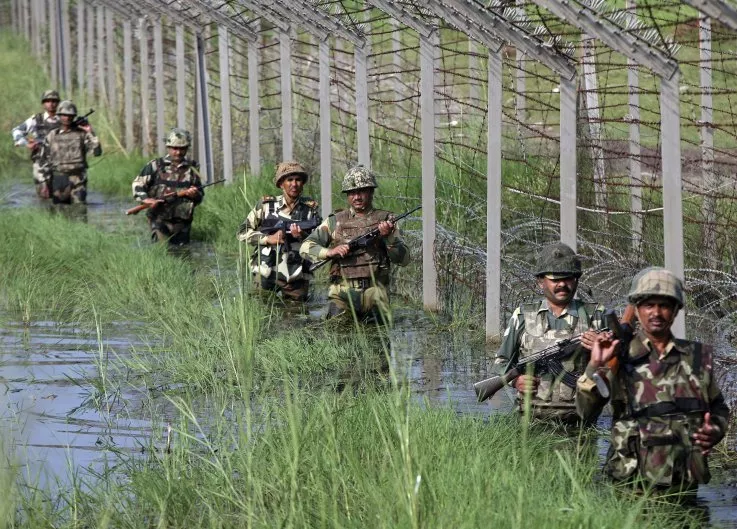
Indian Border Security Force (BSF) soldiers patrol the fenced border with Pakistan as they wade through floodwaters on the outskirts of Jammu September 13, 2014. Mukesh Gupta/Reuters
Despite moments of dialogue and temporary ceasefires, deep mistrust remains. Today, Kashmir is one of the most volatile regions on the planet, where a single incident can spark an international crisis with global consequences.
Recent Flashpoint: Kashmir Massacre and India’s Strikes
In April 2025, gunmen attacked a group of tourists in Pahalgam, Indian-administered Kashmir, killing at least 26 people — most of them Hindu pilgrims. An Islamist militant group, The Resistance Front (TRF), initially claimed responsibility. India swiftly blamed Pakistan for sponsoring terrorism and launched a series of retaliatory steps: diplomatic expulsions, suspension of visas, trade halts, and revoking water-sharing agreements.
Cross-border shelling followed, escalating daily through April and early May. Then, in the early hours of May 7, India launched Operation Sindoor — a set of missile and air strikes deep into Pakistan. Indian jets struck alleged terror training camps belonging to Jaish-e-Mohammed and Lashkar-e-Taiba, claiming to avoid civilian casualties.
Pakistan reported that the attacks killed at least 31 civilians, including worshippers at a mosque in Muzaffarabad. It accused India of violating its sovereignty and vowed retaliation. Prime Minister Shehbaz Sharif labeled the strikes an “act of war,” promising a calculated response.
On the Edge: Standoff, Diplomacy, and a Fragile Calm
Following India’s missile and air strikes on May 7, Pakistan responded with force and fury. Its military claimed to have shot down multiple Indian aircraft, including advanced Rafale jets, and scrambled fighter planes to patrol the skies. Wreckage of at least one downed jet was found near the Indian border, though New Delhi remained tight-lipped about its losses. Villages near the Line of Control were evacuated on both sides, as artillery duels and drone attacks created panic among civilians. Homes were destroyed, children were injured, and families were forced into underground shelters.
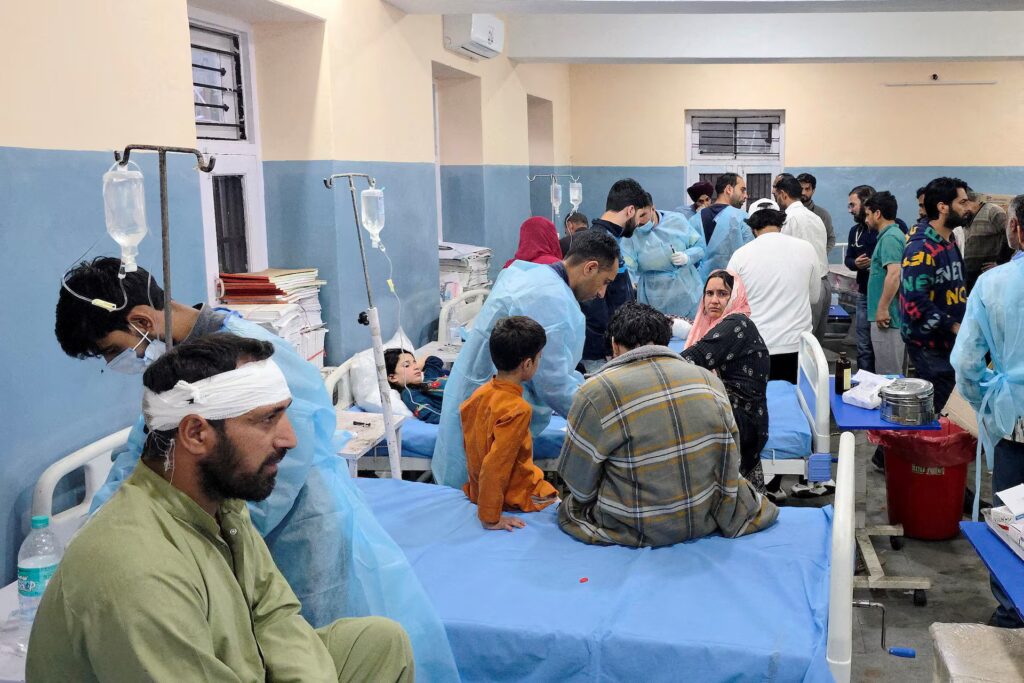
People who, according to their relatives, were injured in a cross border shelling in Uri sector receive treatment in a hospital in India-administered Kashmir’s Uri, May 7. REUTERS/Stringer
What followed was a tense standoff, with both militaries on high alert and political leaders trading warnings. Pakistan’s prime minister vowed that India would “pay a price,” while India’s government insisted its actions were defensive and aimed strictly at terrorist infrastructure. The situation was volatile, and for a few days, the region hovered on the edge of full-scale war.
Global powers moved quickly. The United Nations, United States, China, and the European Union all called for immediate de-escalation. American and Gulf state diplomats engaged both governments in backchannel talks. International flights were rerouted, stock markets wobbled, and even India’s popular cricket league was suspended as security fears rippled through the region.
After days of mounting tension, diplomacy finally made a breakthrough. On May 10, both countries agreed to a ceasefire. The announcement brought relief to millions living along the border, and the shelling largely came to a halt. While both sides declared victory — India for demonstrating its resolve against terrorism, and Pakistan for defending its sovereignty — the truce underscored just how close the world had come to witnessing a dangerous escalation between two nuclear-armed neighbors.
The ceasefire remains fragile. Skirmishes haven’t stopped entirely, and rhetoric from both governments still runs hot. But for now, diplomacy has bought time, and with it, a chance — however slim — for cooler heads to take the lead.
The Bigger Picture
The India–Pakistan conflict remains one of the most dangerous rivalries on Earth. Its roots stretch back to partition, but its consequences reach far beyond the subcontinent. With every flare-up, from Pulwama to Pahalgam, the stakes rise. For now, diplomacy has once again prevented disaster. But as long as Kashmir remains contested and extremist groups continue to provoke violence, the risk of future conflict remains.
Peace demands more than ceasefires — it requires political will, regional cooperation, and global engagement to address the root causes of this enduring and volatile dispute.
Sources: Official statements from India’s Ministry of External Affairs and Pakistan’s Ministry of Foreign Affairs; reporting from CNN, Reuters, BBC, NPR, Al Jazeera, The Guardian, and The Economic Times; conflict background and analysis from the Council on Foreign Relations and Global Conflict Tracker; on-the-ground interviews via Associated Press and AFP; global diplomatic responses via White House press briefings and UN Secretary-General statements.